How To Build an Affiliate Network for Explosive SaaS Growth
The way SaaS companies grow is changing. Smart companies are turning to innovative, decentralized models as traditional marketing tactics like paid ads and direct sales lose their edge. An affiliate … How To Build an Affiliate Network for Explosive SaaS Growth
The way B2B SaaS companies acquire customers has changed.
Traditional tactics like paid ads and direct sales are losing their edge, so more teams are paying other people to sell for them.
An affiliate network sits at the centre of that shift: a curated pool of external promoters, including bloggers, influencers, consultants and industry experts, who join your program and promote your product.
Build one and you get a system where other people carry the cost and the risk of promotion, and you pay based on the results they produce.
This guide walks through the steps to build an affiliate network that actually produces revenue for a SaaS business.
You will learn how to pick the right affiliates, mine the relationships you already have, and keep partners producing once they have signed up.
First, why the network is worth the work it takes to build.
The value of an affiliate network: Scaling your SaaS from outside
Building an affiliate network takes planning and ongoing work before it pays off. Knowing what a working SaaS affiliate network returns is what keeps you committed to the process.
These are the eight returns that compound once an affiliate program is running, and they are the reason a network becomes a long-term growth engine rather than a side channel.
- Diversifying customer acquisition channels: Paid ads and an in-house team give you two levers, and both stop working the moment budget or headcount is cut. A network spreads acquisition across multiple independent promoters, each with their own segment, platform and audience.
- Scaling without heavy resource investment: Affiliates bring traffic, leads and sales without another headcount on your payroll. You skip the recruitment, training and salary cost of the marketers who would otherwise have to produce that volume.
- Increasing market adaptability: Affiliates react quickly to shifts in buyer behaviour or a competitor launch, because they are not waiting on your campaign calendar or a design queue. That agility keeps your brand present while internal campaigns are still in review.
- Lowering customer acquisition cost (CAC): Affiliates are paid on results, usually a signup or a paid conversion, so there is no upfront media spend to write off when a campaign flops. Commission comes out of revenue that already landed, which pulls blended CAC down and frees budget for other channels.
- Accessing niche audiences: Affiliates own relationships in narrow markets, a newsletter for RevOps leads or a community of agency owners, that your internal team would struggle to build from scratch. Their reach gets you into specialised segments you cannot buy your way into.
- Building credibility with key industry players: When a respected consultant or reviewer in your category puts your product in front of their audience, that recommendation carries real weight. Their endorsement reads as a vetting signal to buyers who have never heard of you.
- Enabling faster feedback on marketing campaigns: Affiliates tell you quickly which angle, offer or headline their audience responded to. That loop feeds straight back into your product positioning and paid messaging.
- Creating a competitive moat: Rankings, review posts and comparison pages built by loyal affiliates take time to accumulate, and a rival cannot buy them back. Affiliates who earn well from you keep promoting you, which is the part competitors struggle to replicate.
The rest of this guide is the build itself, in the order the work has to happen, starting with what has to be true about your product before you recruit anyone at all.
5 strategic steps for building your own affiliate network
An affiliate marketing network is not a signup form with partners behind it. It takes planning, deliberate recruitment and constant tuning after launch. Every affiliate has to match your brand and your customer base, and the program has to be built so partners trust the tracking, get paid on time, and stay long enough to compound.
The five steps below work whether you are launching a first affiliate program or fixing one that has stalled. They cover who to recruit, how to reach them, and how to turn the network into a predictable channel inside your SaaS affiliate marketing strategy.
#1 Lay the groundwork with a validated product and clear ICP
Your SaaS needs a foundation before affiliates arrive. Two things in particular have to be true before you send a single recruitment email:
- A validated product, one that is already proving its value with paying customers rather than in demos.
- A clear understanding of your Ideal Customer Profile (ICP), meaning you know exactly who your product serves best: their role, company size, pain points and buying triggers.
Recruit before both are in place and you burn your own time and your partners' goodwill on promotions that were never going to convert.
Why does a validated product matter?
A validated product is one you have already reshaped around real customer feedback, with retention and support tickets to show where it holds up. Affiliates only promote what they expect their audience to like. Send them at a product that has not found traction yet and you spend their reputation as well as your own.
Affiliates are paid on results, so they behave like it. A partner who sends traffic without earning a commission moves on to a program that pays, and you are back to recruiting for the same slot. That turnover is the hidden cost of launching a program too early.
A useful bar is $10K MRR (Monthly Recurring Revenue). Hitting it means enough companies pay you every month that demand is no longer in question, and. For an affiliate, that number is the signal that they are promoting something with momentum rather than something still hunting for market fit.
Defining your Ideal Customer Profile (ICP)
Your ICP does double duty: it points your own marketing, and it tells you which affiliates are worth approaching. Affiliates perform when their audience overlaps with your best customers. Without a written ICP you end up approving partners who reach the wrong job titles, the wrong company sizes, or people who will never pay for the tier your product sells at. Those partners still promote, and their clicks convert at a fraction of the rate.
With the profile written down, finding affiliates who already serve that audience becomes a search problem rather than a guess. They can write copy aimed at a buyer they know, which lifts conversion rates and keeps the partner earning enough to stay. It also gives you a yes or no test for every application that lands, so you approve on fit instead of follower count.
#2 Determine the ideal affiliates for your network
With the product proven and the ICP written, the question becomes which affiliates to go after. Who you approve matters more than how many. Look for partners with direct access to your ICP and a name your buyers already trust, because those are the ones who return anything on the time you put into SaaS affiliate marketing.
What makes a great affiliate partner?
Four characteristics separate a high-quality affiliate hire, the kind who produces, from one who signs up and then disappears:
- Audience relevance: Their audience has to overlap with your ICP, not just sit near it. A creator who reviews workflow and productivity tools for operations teams is a fit for a B2B SaaS product those teams buy, while a general startup newsletter is a much weaker one. The tighter the overlap, the fewer clicks it takes to produce a paying customer.
- Trust and authority: The audience has to act on their recommendations. Influencer, consultant or blogger, the partner should hold a position that people in your niche already defer to. Trust is what turns a mention into a trial signup, and it is why a small, trusted audience can out-convert a much larger one.
- Content quality and promotional style: Their content style has to sit comfortably next to your brand. Promotion that reads as bought gets ignored, and B2B buyers spot it quickly. Look for partners whose blogs, videos, social posts or webinars would be worth reading even without an affiliate link in them.
- Proven track record: Ask what they have promoted before and how it performed, ideally in your industry. Partners who have run SaaS offers already understand recurring commission, trial-to-paid lag and why a signup is not yet a sale, so they ramp up more quickly.
Exploring indirect marketing channels
Direct audience overlap is the obvious place to look, but indirect channels are worth exploring too. Affiliates in adjacent industries may never mention your product category by name and still sit in front of the people who sign the contract. A business consultant who fixes operational processes can recommend your SaaS as one piece of a wider engagement, and the client takes that as advice rather than an ad. Those partners reach your ICP through an alternative channel, which opens up opportunities you would not have found by searching your own keywords.
Write this partner profile down before you start recruiting, the same way you wrote down your ICP. It becomes the filter for every outreach list and every inbound application, and it stops you filling the network with affiliates who look busy and sell nothing.
#3 Harness existing relationships for instant affiliate wins
The easiest affiliates to sign are already in your database: current users, agency partners and the people in your own professional circle. They know the product, they can answer a prospect's question without a battlecard, and their recommendation converts because it comes from someone who actually uses the thing. They also cost almost nothing to recruit, which matters early on when nobody outside has heard of your program.
Three groups are worth working through in order, and each needs a different approach: your existing users, your agency and consultant partners, and the founders and advisors in your own circle.
Existing users
Your existing users are some of the strongest candidates because they have run the product in their own stack and hit the problem it solves. They can describe the before and after without being coached, and they need almost no onboarding beyond a link and a commission structure.
Give them a referral or affiliate marketing program that pays for the introductions they were half-making anyway. Customers who have got a result from your product already recommend it in Slack groups and on calls, and a commission makes it worth their while to do it in public.
Reach out individually, and reference their actual usage: the workflow they built, the number they moved, the result they posted about. A message that proves you looked at their account works better than a program-wide announcement email, and it tells them you trust them to represent the brand.
Agency and consultant partners
Agencies and consultants are the second group. They already serve a roster of companies that match your ICP, and they can fold your product into the stack they set up for every new client. Their clients hire them for exactly that judgement, so a recommendation from them lands as expertise rather than promotion.
Pitch them on what your product does for their engagement, not on your feature list: fewer manual hours, a reporting layer they can put their name on, an outcome they can bill for. Then pair it with recurring commission on every client they bring across, so the account keeps paying them for as long as it keeps paying you.
Professional peers with influence
Most SaaS founders sit in a network of other founders, former colleagues and advisors, often tightened by an accelerator like Y Combinator or a paid community. Those people run companies with the same problems yours solves, they trade tool recommendations constantly, and they understand what building software actually involves. Turning that into an affiliate relationship usually costs one conversation.
They also have reach you cannot buy. An accelerator alumni network is full of companies that all know each other, and one recommendation in that Slack gets read by people who are actively shopping. Coming from a peer with no obvious reason to shill, it carries weight, because they are seen as trusted voices.
Keep the approach informal. A catch-up call or a LinkedIn message beats a templated partner pitch with a deck attached. Lead with what their contacts get out of it, lean on the history you already have, and make the offer simple: one commission rate, one link, no tiers to explain. Complexity is what kills these conversations.
Start here, and start here first. With a stranger, you have to convince them your product is worth recommending before anything else can happen, and that is the slow part of recruitment. People who already know you skip that step entirely, which is how you break the ice quickly. Work through your own user base, your newsletter list, your footer, and in particular any consultants or agencies already using the product, who deserve a different approach from a cold prospect. Whatever you do in your first weeks determines what months two, three and four look like, so a passive start is expensive later.
#4 Conduct proactive search and outreach
Your own network eventually runs out. After that you have to go and find people, using competitor data, search data and the creators already publishing in your category. Four methods do most of the work.
Target competitor website traffic sources
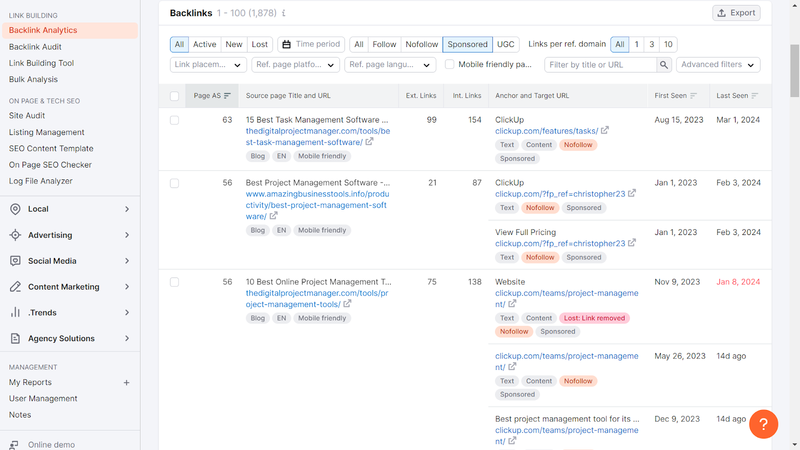
Identifying sponsored backlinks using Semrush.
Pull your closest competitor's backlink profile and you are looking at a list of their affiliates. Product reviews, comparison pages and sponsored content almost always sit behind a tracked link, and the pattern is easy to spot once you filter for it. Semrush and Ahrefs will both export it, and the sites that appear against several competitors at once are the ones to contact first.
These partners are already monetising your exact audience, so the pitch is a commercial one: a higher rate, a longer attribution window, a flat fee to add you to a page that already ranks. They need no education on the category and no hand-holding on the offer, which means they can be live quickly, using a relationship your competitor built.
Partner with high-ranking content creators
The people who own the “best tools” roundups and “top alternatives” lists have already done the hard part: they rank for the searches your buyers run before they shortlist. A spot on one of those pages puts you in front of demand that is already qualified. Use SEO tools to find the high-traffic pages ranking for your category keywords, note who owns page one, and approach them with an affiliate commission plus something they want, a co-marketing slot, data for their next post, early access to a feature. It costs a share of revenue instead of a media budget, and it buys credibility as well as exposure.
Convert organic mentions into partnerships
People already write about your product without being asked, in blog posts, review sites, social media and social media. Every one of those is an affiliate who has not been offered a commission yet. Track the mentions with Google Alerts, then reach out directly and offer to make the link a tracked one so they earn from a post they were going to publish anyway. It takes almost no friction, because the promotion already exists and the interest is proven.
Use a dedicated partner outreach tool like Reditus Recruit
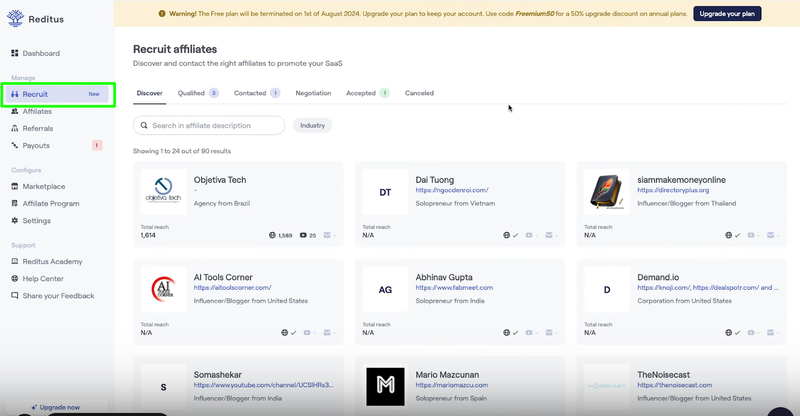
Screenshot of Reditus Recruit tool interface.
Doing all of that by hand is slow, which is what Reditus Recruit is for. You search an extensive affiliate directory and filter by traffic, geographic reach and how partners have performed for other companies in the Reditus network, so you are not judging an affiliate on their homepage alone. Each profile shows performance history, audience detail and the pricing model they work on, and the tool carries you from first search through to negotiation in one place instead of a spreadsheet and a mail merge.
#5 List your affiliate program on a reputed marketplace to put network expansion on autopilot
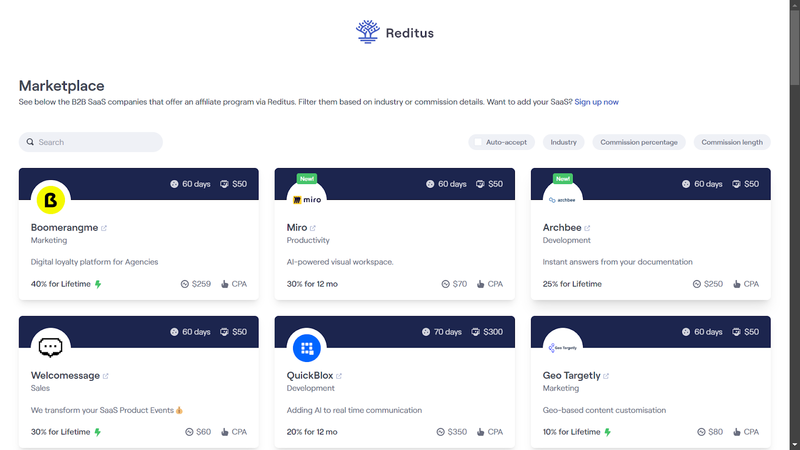
Screenshot from the Reditus Marketplace landing page.
Outreach is push. A marketplace listing is pull, and it keeps working while you do something else. Affiliate marketplaces are the central hub where thousands of affiliates go looking for programs that match their niche and expertise, which means applications start arriving without you sending an email.
What a marketplace listing does for your network's growth:
- Wider audience access: You get in front of a pool of affiliates far larger than your own outreach reaches, including partners who would never otherwise have heard your name.
- Streamlined recruitment: Affiliates apply to your program through the platform, so your work shifts from chasing to screening, and the screening happens against a profile you can actually check.
- Scalable growth: The listing keeps producing applications long after you publish it, so recruitment stops being a campaign you have to keep restarting.
Grow your network with the Reditus Marketplace
For B2B SaaS specifically, the Reditus Marketplace is built around that audience rather than retail or e-commerce offers. It puts your program in front of a network of more than 26,000 B2B SaaS affiliates, so the partners who see it already promote software to business buyers.
Other parts of the listing worth knowing about:
- Auto-accept feature: Approval can run automatically, so an affiliate who applies at midnight has a working link and can start promoting before you have read the notification.
- Detailed affiliate profiles: Every application arrives with traffic stats, audience demographics, performance history and what that affiliate has produced for other SaaS referrals, so you approve on evidence rather than on a bio.
- Advanced filters for affiliates: Affiliates filter by industry, commission percentage and commission duration when they browse. Your listing therefore surfaces for partners whose criteria your program already meets, so the affiliates who apply are aligned with your program's goals and niche.
Marketplace listing success story: Expandi's growth on Reditus
Expandi, a LinkedIn automation tool, is the worked example. In 12 months on Reditus they onboarded more than 340 new affiliates and generated over $135k in revenue through Reditus affiliates alone.
Stefan Smulders, CEO of Expandi, on why they ran it alongside their existing program:
We started with Reditus to see the effect of the marketplace and were happily surprised with the results. Running Reditus parallel to our existing program allowed us to test the platform without needing to migrate our affiliates right away.
The listing gave Expandi a recruitment channel outside its own network, running alongside the program it already had rather than replacing it. The full story is here.
Maximizing your marketplace listing potential
A listing is a sales page aimed at affiliates, so treat it like one. State the commission rate and how long it recurs, say what marketing support and promotional resources you provide, and add logos and banners so the entry does not look abandoned. Then engage promptly with the affiliates who apply.
Done properly, a marketplace listing takes recruitment off your weekly to-do list and keeps adding partners in the background, which is how a program keeps growing without a partner manager working on it full time.
A warning about recruiting the big names first
The instinct when building a network is to go after the largest publishers available. They will ask for considerably more money upfront, and what they deliver in exchange is usually undefined.
One company we work with paid over $10,000 upfront and got ten clicks for it. Nothing could be done, because no outcome had been agreed: the deal promised visibility, and visibility is not something you can hold anyone to. Never commit a large upfront sum without written expectations and defined outcomes. A hybrid structure, with a smaller upfront payment and the remainder tied to work actually delivered, protects you without scaring off serious partners.
Tips to unlock the value of each individual in your network
Recruitment gets partners in the door. Keeping them is the harder part, because an affiliate with no assets, no data and no contact goes quiet. Four things keep them producing.
- Provide clear onboarding resources: A smooth start decides whether an affiliate ever posts. Run an automated email sequence and a checklist that walks them through generating their link, understanding what the product does and who it is for, and finding the banners and copy you have prepared. Every step they have to ask you about is a step where they stall.
- Track and share performance insights: Give every affiliate a personalised dashboard showing clicks, conversions and commissions in real time. Partners who can see which post produced a signup write more of that post. Send the numbers proactively too, a short regular note with their totals and their best-performing channel, because not everyone logs in unprompted.
- Foster open communication and feedback: Keep a channel open in both directions. A standing check-in with your top partners and an easy way for the rest to ask questions, over email, Slack or inside the platform, is what surfaces the objection they keep hearing from their audience. That feedback is worth as much as the referrals.
- Create a collaborative community: Put your affiliates in a room together, even a private Slack or LinkedIn group. Partners pick up tactics from each other, and a virtual meetup where a top performer explains what worked motivates the rest.
Pro tip: Doing all four by hand stops scaling as the network grows. SaaS affiliate platforms like Reditus handle the mechanics: onboarding sequences, incentivization and performance tracking, so your time goes on the partner relationships instead of the admin behind them.
Fuel your SaaS growth with a well-built affiliate network
An affiliate network can get more efficient as it grows, because every new partner adds distribution without adding fixed cost.
The steps are the same in every case: validate the product and write down your ideal customer profile, decide which affiliates fit it, work the relationships you already have, then recruit deliberately through competitor backlinks, ranking content and a marketplace listing, and support the partners you sign.
Do that and you end up with a channel that accelerates customer acquisition, reduces marketing costs, and keeps producing over the long term.
The part that breaks first is the admin. Tracking, commission calculations, payouts, onboarding and reporting across a growing network will eat your week unless the right tooling is doing it.
That is where Reditus comes in.
Reditus covers the whole path: setting the program up, growing the network through its marketplace and the Recruit tool, and managing affiliate performance once partners are live.
Request a demo of the Reditus platform today and run your SaaS affiliate marketing strategy on infrastructure built for it.

Meet the author
Back in 2020 I was an affiliate for 80+ SaaS tools and I was generating an average of 30k in organic visits each month with my site. Due to the issues I experienced with the current affiliate management software tools, it never resulted in the passive income I was hoping for. Many clunky affiliate management tools lost me probably more than $20,000+ in affiliate revenue. So I decided to build my own software with a high focus on the affiliates, as in the end, they generate more money for SaaS companies.
What Is Affiliate Management and How To Do It Right in 2026?
Affiliate programs are critical growth engines for SaaS startups. They drive new signups and expand market reach through external partners. However, robust management is the backbone of any effective program. … What Is Affiliate Management and How To Do It Right in 2025?
SaaS Affiliate Marketing: How to Start and Scale an Affiliate Program
A practical guide to launching a SaaS affiliate program, growing it into a real revenue channel, and migrating one that has stalled. Built from what actually works for B2B SaaS.
What is Affiliate Marketing Strategy: Guide for B2B SaaS
Wondering what is affiliate marketing strategy? Our comprehensive guide offers actionable steps and proven strategies to elevate your B2B SaaS business.