How To Set Up an Affiliate Program? 2026 SaaS Edition
Setting up an affiliate program for your business goes beyond just creating a landing page – it's about getting the foundational pieces right from the start. That's why this guide … How To Set Up an Affiliate Program? 2024 SaaS Edition
Setting up an affiliate program for a B2B SaaS company takes more than a landing page and a sign-up form. The pieces you put in place first, your ICP, your commission model and your tracking, are what decide whether the program ever pays for itself.
So this guide is not a checklist you skim once and forget.
It works through each foundational step in the order you need it, so the program still holds together once affiliates start sending real volume and the edge cases arrive with them.
It covers what actually goes into setting up an affiliate marketing program for SaaS companies: defining your ideal customer profile (ICP), building a recruitment strategy that matches your business objectives, designing a commission structure affiliates will work for, automating onboarding, and much more.
It also covers the tooling that ties those steps together and turns partner activity into revenue you can bank.
Work through it and you will have an affiliate program built for partner-driven MRR growth, rather than one that stalls early.
The first step is the customer profile everything else hangs off.
#1 Define your ICP properly if you haven’t done it before
Affiliate recruitment is a targeting problem before it is a partnerships problem. If your SaaS marketing plan already carries a defined Ideal Customer Profile (ICP), use it to shortlist affiliate marketers who can genuinely engage those buyers. If you have never written one down, or it has drifted since your last pricing or positioning change, fix that before you recruit anybody.
A sharp ICP is what keeps your affiliate recruitment pointed at the right audience. Get it right and your partners are talking to people who already have the problem your software solves, which is where the difference in conversion rates comes from.
Some actionable steps to define your ICP include:
- Analyze existing customer data: Go through your current customer base for demographics (age, gender, location), firmographics (industry, company size), and behaviors (buying patterns, product usage, feedback). The accounts that renew and expand tell you more than the ones that merely signed up.
- Collaborate with sales and support teams: Sales can tell you what your most successful customers have in common. Support can tell you which problems and questions come up again and again, which gives you a clearer picture of what those customers actually need.
- Segment your audience: Group customers into segments by shared characteristics and behaviors, then rank those segments by profitability and by how well they fit your product.
- Develop detailed customer personas: Build a persona per segment covering demographic and firmographic details, pain points, and how they make decisions. Base them on real customer data rather than on what the team assumes, or the affiliates you recruit will inherit the guesswork.
Joran Hofman, founder of Reditus, a SaaS affiliate management software, puts it bluntly:
“It’s crucial to have your ideal customer profile defined so you can identify who has access to them in bulk.”
#2 Finalize your revenue-sharing (commission) model
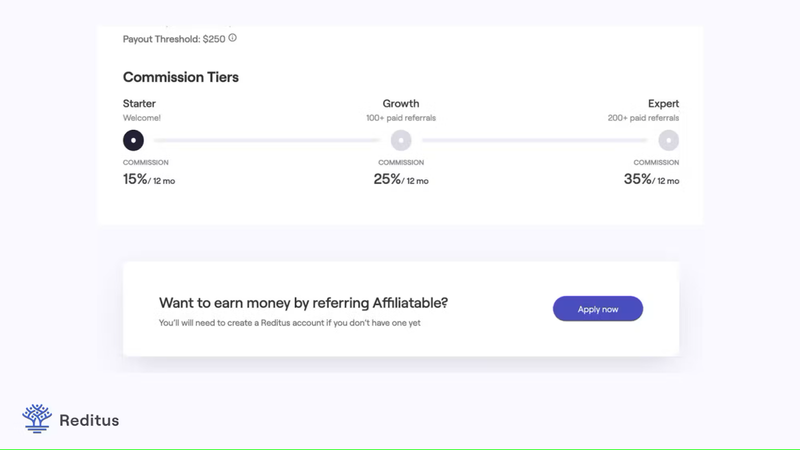
Setting up a tiered commission structure with Reditus.
Your revenue-sharing model decides how hard an affiliate marketer works for you. Lucrative commissions attract top affiliates and keep them promoting consistently, which drives more sales and increases your revenue. The bigger choice is recurring versus one-time: a one-time bounty buys you a single push, while a recurring share of MRR gives partners a reason to keep sending traffic for as long as the customer stays. A fair, attractive structure puts their earnings and your growth on the same side.
Some actionable steps to craft an attractive commission structure include:
- Try longer cookie duration: Push cookie durations past the standard 30 days, to 60 or 90. Longer windows give affiliates a better shot at earning the commission, which matters most when your sales cycle runs long.
- Explore examples: Look at the affiliate revenue model examples already running in the industry and pick the best fit for your business. The common models are:
- Pay-per-sale (PPS): Affiliates earn a commission only when their referrals turn into sales. It works when your sales funnel is clear and trackable end to end.
- Pay-per-click (PPC): Affiliates are paid on clicks generated, whether or not those clicks convert. Use it when you are buying traffic and brand awareness, and watch the traffic quality closely.
- Pay-per-lead (PPL): Affiliates earn on leads, such as free trial sign-ups. It suits high-ticket products, or ones that need customer education before anyone buys, because the affiliate gets paid for work your sales team then finishes.
- Hybrid models: Combine models across products or marketing goals, for instance PPS on direct sales and PPL on trial sign-ups, so each motion is paid for what it is actually worth.
- Research competitor offerings: Check what your competitors pay so your commission rates hold up next to theirs. Once you know the market standard you can offer slightly better terms and win the high-quality affiliates who would otherwise sign with them.
- Offer tiered commissions: Set a tiered commission structure where partners move to a higher rate once they pass a sales threshold. It gives your affiliates a reason to keep promoting your SaaS product instead of drifting to the next program. Reditus lets you build and edit those tiers yourself, so the offer stays attractive and fair to everyone in the program.
- Provide exclusive incentives for top performers: Give your best affiliates bonuses or higher rates to keep them loyal and promoting. Early access to new features, bonuses for hitting milestones, personalized support and exclusive marketing materials all do the job.
Decide the surrounding terms at the same time, not later. The commission percentage is only one of four decisions, and programs that get into trouble usually left the other three vague: how long the cookie period runs, what the payout threshold is, how long your affiliate terms last, and how long you keep paying commission on a referred customer. Settle all four before you publish the program, state them plainly on your program page along with what affiliates may and may not do, paid search included, and most of the disputes people worry about never arise. You keep full control either way: if a partner breaks the rules you can remove them.
#3 Pick a SaaS-focused affiliate management software

Screenshot from Reditus website.
Running a program on spreadsheets stops being workable as the partner count grows, so the platform you pick to execute your affiliate marketing strategy is an early decision, not a later one. The right one takes the administration off your plate and leaves you on strategic growth. Reditus is one of the top SaaS affiliate platforms to weigh up when you set up your own affiliate program, covering the full lifecycle from initial launch through ongoing management and optimization.
Here is what Reditus gives a B2B SaaS team operating an affiliate program:
- Low-risk start: A 14-day free trial with no credit card, so you can set up and test the affiliate platform before you pay, then transparent plans from $99 per month on annual billing. You get to validate the whole thing with almost nothing up front.
- Specialized for B2B SaaS: Reditus is built only for B2B SaaS companies, so every feature answers a problem SaaS teams actually have. That focus is what shapes the tooling behind your SaaS affiliate marketing efforts.
- Quick and easy setup: You can go live with a custom landing page and partner sign-up page in under 30 minutes, which means recruiting affiliates can start the same day you decide to run a program.
- Added value beyond the basics: Reditus is more than an affiliate program application form builder. Its marketplace puts your program in front of a large network of affiliates who already recommend software like yours to their audience.
- Integrations that carry the data: Stripe connects directly, which keeps subscription management and referral tracking in sync, and Calendly integrates as well.
- Support you can actually reach: A help center with detailed documentation, real-time chat support and email assistance, so you can get the help you need whenever an issue comes up.
- Easy migration: Switching from another platform is a supported move. Reditus transfers your affiliates and their referrals across without duplicating commissions along the way.
Those are the points SaaS teams actually weigh when they shortlist affiliate marketing software, and Reditus is built to answer all of them. It is what shortens the gap between deciding to run an affiliate program and having one live and tracking.
#4 Publish your affiliate program and sign-up page

Screenshot from affiliate program landing page of Expandi, a LinkedIn automation tool provider that uses Reditus.
Your program page and sign-up page are where an interested affiliate decides whether you are worth their audience. They are the main touchpoints, the place where someone learns about the program and chooses to join, and they need to answer three questions fast: what do I earn, on what, and for how long. Clear, specific pages get sign-ups. Vague ones lose affiliates who have other programs to choose from.
Here are some actionable steps to create an effective affiliate program and sign-up page:
- Provide clear and concise information: Spell out the benefits of joining, the commission structure, the cookie window and exactly how and when affiliates get paid. Use straightforward language, so potential partners know what you offer and what you expect back from them.
- Use compelling call to action (CTA) buttons: Point visitors at the sign-up with strong CTAs. Phrases like “Join Now” or “Become an Affiliate” should be prominent and repeated, placed where nobody has to hunt for them before they lose interest.
- Design page for user-friendliness: Keep both pages easy to navigate with a clean, professional design. Bullet points, headings and visuals break up the text, keep the page engaging, and help visitors find the information they need quickly.
- Add a link to your website footer: Make the program page reachable from your main website. In the footer it shows on every page, so it is visible to visitors who arrived for a blog post or a pricing comparison and turn out to be good affiliates.
- Showcase partner testimonials and success stories: Include testimonials or case studies from current affiliates. Real earnings from real partners build trust far better than a list of program features, and they answer the question every affiliate has about whether the program pays.
Pro tip: If you use Reditus, your program landing page and sign-up page can be live in a matter of minutes.
#5 Configure affiliate link and conversion tracking
Tracking is the part affiliates judge you on. Get attribution wrong and they stop promoting, and they will spot the gap before you do. Done properly it pays partners exactly what they earned, which is what keeps them motivated and keeps their trust, shows you which of them deserve extra support, and gives you the performance data your affiliate marketing strategy runs on.
Here are some actionable steps to configure affiliate link and conversion tracking properly:
- Assign unique links to affiliates: Give every partner their own link so traffic and conversions land against the right account. That removes the guesswork and gives you precise numbers on each affiliate’s performance.
- Implement a tracking script: Run a tracking script on your website to record clicks and conversions. It drops a cookie on the visitor’s device when they click an affiliate link, which is how their later actions get credited to the right partner.
- Set cookie duration: Match the tracking cookie window to your program’s needs. It controls how long after that first click an affiliate still gets credit for the referral.
- Integrate with payment platforms: Connect tracking to the payment platform your SaaS already bills through, which for most companies is Stripe. That link between visitor activity and actual purchases is what makes commission payouts accurate.
Pro tip: Setting up the tracking script with Reditus takes one small piece of code on your site, and it starts collecting data straight away. That is what gives you accurate attribution and efficient management of your program, alongside the other affiliate marketing tools you need. Our video tutorial walks through the setup step by step.
#6 Develop an automated affiliate onboarding flow
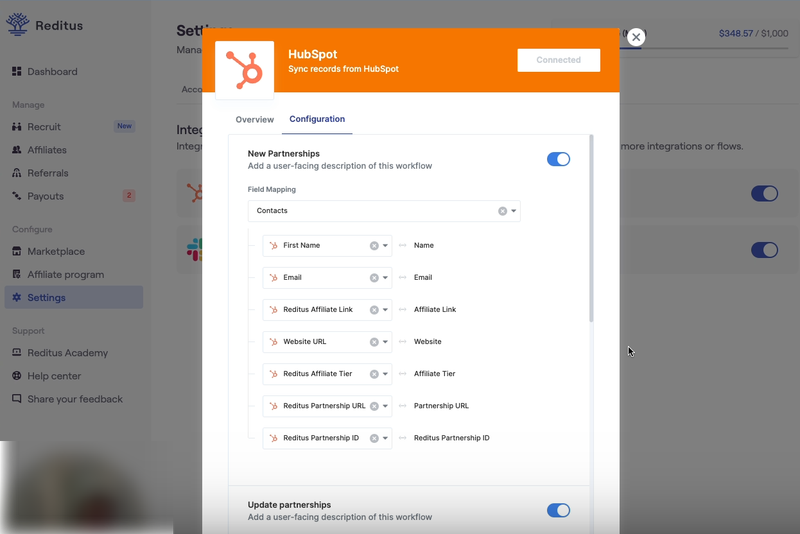
Screenshot from Reditus- HubSpot integration configuration interface.
Plenty of affiliates sign up and never send a single click. An automated onboarding flow moves them from approved to promoting without waiting on you: they learn how the program works, get their account set up, and can start promoting your product quickly.
Here are some actionable steps to create an effective affiliate onboarding flow:
- Provide easy access to affiliate links: Affiliates should find their unique link immediately, and be able to create custom links for specific campaigns without asking you for them.
- Set up their dashboard: Give each affiliate a personalized dashboard where they can monitor their performance, earnings and the other metrics that tell them whether the effort is worth repeating.
- Collect payout information: Ask for their preferred payment method during onboarding, so the first commission payment is not held up while you chase bank details.
- Ensure agreement to terms and conditions: Have affiliates review and accept your program’s terms and conditions. It sets clear expectations on both sides and gives you legal protection if a partner promotes in a way you did not sanction.
- Automate email communication: Set up automated emails that walk new affiliates through onboarding and hand them the information and support they need at the point they need it.
- Share marketing and support materials: Give them training videos, boilerplate marketing copy, banners, logos, guides and FAQs, so they can learn your product and promote it without writing every asset from scratch.
Pro tip: Reditus builds most of this flow for you. It generates unique links, sets up dashboards, collects payout information and captures agreement to your terms automatically. It also connects to HubSpot and Slack, so affiliate application data syncs across and you can nurture new partners through email sequences, with training materials and support built into the flow.
For a fuller guide on how to automate affiliate marketing, check out the linked article.
#7 Set up the payout workflow
Late or wrong payouts cost you good affiliates. Automating the payout run takes the scramble and the arithmetic errors out of it, and pays partners accurately and on time without you touching a spreadsheet. Fraud checks sit alongside it, stopping you from paying commission on self-referrals and charged-back cards.
Here are some actionable steps to create a secure and efficient payout process:
- Set minimum payment thresholds: A payout threshold, say $100, keeps processing fees and administrative work down by batching small balances into one payment.
- Automate payments: Use a service like Stripe to pay out automatically, and still double-check the transactions before they go.
- Spot self-referrals: Cross-reference IP addresses and match affiliate domains against the referrals they are claiming commission on.
- Monitor brand-named ads: Put tools in place that flag paid ads bidding on your brand name, so you are not paying commission on traffic you would have won anyway.
- Guard against credit card fraud: Set alerts for high refund rates or for multiple sign-ups coming from a single IP address.
Pro tip: Reditus automates the ‘who,’ ‘when,’ and ‘how much’ of payouts, which cuts the time this task costs you. It connects to Stripe to move the money and runs advanced fraud detection algorithms, so what leaves your account is legitimate.
Set the threshold from the affiliate's side of the table. Thresholds of $200, sometimes $500, are still common and they are a mistake. Even $100, which feels modest to you, often means an affiliate must generate five to ten commissions before seeing any money, and for a partner who joined last month that is a very long wait for proof that your program pays at all. Set it so they are paid after two or three commissions. The first payout is the moment the relationship becomes real, and bringing it forward buys more activity than almost anything else at this stage. The same goes for method and currency: the moment you insist on one payout rail, you start losing good affiliates, agencies and consultancies among them.
#8 Start recruiting affiliates to kick things off
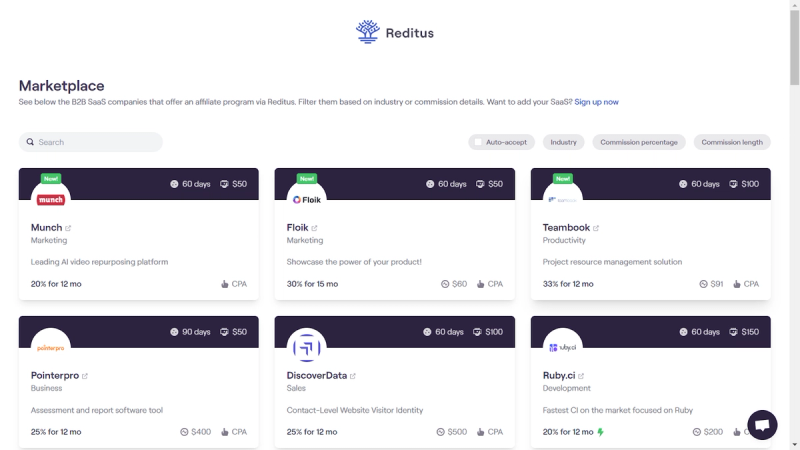
Screenshot from the Reditus Marketplace
Recruiting top affiliates is what decides whether the program works, so recruitment quality beats recruitment volume. The partners worth having already reach your buyers, expand your presence in the market, lend credibility through their endorsement, and drive sales big enough to show up in your MRR rather than a trickle of unqualified trials.
Here are some key channels to recruit high-quality affiliates:
- Tap into your existing user base: Start with current customers who already use and like your product. They have firsthand experience and genuine enthusiasm, which is hard to buy anywhere else. Bring them in with incentives such as exclusive commissions or early access to new features.
- Work your professional network: Consultants, agencies and business partners already know your product and what it does, which makes them strong affiliates for your SaaS. Personalize the outreach around how the partnership pays both sides, and offer tailored support so they can actually sell it.
- List on affiliate marketplaces: Post your program on established affiliate networks and marketplaces, where affiliates are actively hunting for new products to promote. It widens your reach and the number of quality partners in the program. Make the listing clear, specific and heavy on what the affiliate earns, so it stands out against everything else on the page.
- Analyze competitor backlinks: Run SEO tools like Semrush or Ahrefs over your competitors to find the websites and influencers linking to them. Those publishers already promote similar products, so your program is an easy pitch. Approach the affiliate site owner with a personalized proposition, better terms or an advantage they cannot get elsewhere, and give them a reason to switch focus to your product.
You can check out our full guide to finding and recruiting affiliates for more detailed strategies.
In addition, explore valuable insights in our LinkedIn post on recruiting and motivating B2B SaaS affiliates, which compiles advice from 17 industry experts.
As Nancy Mai Harnett of HubSpot puts it,
“When recruiting affiliate partners for your program, it’s about quality, not quantity. Focus on building long-term, sustainable relationships rather than short-term wins.”
Pro tip: List your program on the Reditus Marketplace to attract top affiliates on autopilot. It is one of the top SaaS-focused marketplaces, and it draws applications from thousands of highly motivated affiliates. Joining requests, onboarding and performance monitoring of every partner run in one place. With over 26,000 SaaS-focused affiliates, a streamlined recruitment process and active recruitment support, Reditus shortens the gap between listing your program and seeing partner-driven MRR growth.
#9 Implement program performance monitoring
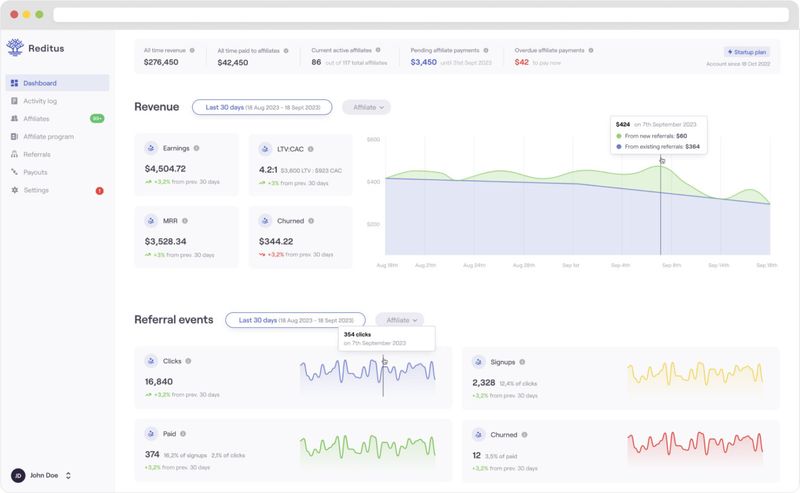
Example of an affiliate program performance dashboard powered by Reditus.
You cannot optimize a program when the data sits in separate tools. Pulling clicks, trials, conversions and commission into one place is what lets you visualize the key metrics and pick up the patterns early enough to act on them.
Here are some actionable steps to set up effective program performance monitoring:
- Identify key metrics to track: Clicks, sign-ups, conversion rates and revenue, plus whatever else tells you how a given affiliate is actually performing against the rest.
- Use a consolidated dashboard: One central dashboard holding all of it, so tracking and analysis do not start with an export and a spreadsheet merge.
- Give access to stakeholders: Everyone with a stake in the program should be able to see the performance data. That is what makes decisions collaborative and keeps the numbers transparent.
Pro tip: Reditus handles the monitoring side with an intuitive dashboard built for B2B SaaS affiliate programs, holding every key metric in one place. It makes trends easy to read, which is what you need in order to optimize strategy as you go.
#10 Have a review and optimization plan in place
Monitoring only pays off if somebody sits down with the numbers on a schedule. A fixed review cadence surfaces the trends and patterns behind the dashboard and gives you a basis for deciding what to change, which is how the program keeps improving instead of quietly drifting.
Here are some actionable steps to set up a review and optimization plan:
- Schedule periodic reviews: Set monthly, quarterly and annual review slots, so program performance gets evaluated consistently rather than whenever somebody remembers.
- Evaluate affiliate performance: Go through the major affiliate marketing campaigns your partners ran and separate what worked from what needs adjusting.
- Make data-driven decisions: Act on what the review found: adjust commission rates, put more support behind top-performing affiliates, and rewrite the marketing materials that are not converting.
- Implement affiliate feedback: Ask affiliates what is getting in their way, then fix it. Their experience of the program and their performance in it move together.
Closing remarks: Initiate your affiliate program right to scale faster
That is the full setup for an affiliate marketing program, from ICP through to the review cadence that keeps it sharp.
Follow these ten steps and you have a foundation solid enough to take on volume, which is what separates a program that scales from one that stalls.
Running it on affiliate management software built for B2B SaaS, like Reditus, takes the manual work out of most of these steps.
Reditus starts with a 14-day free trial and no credit card, with plans from $99 per month on annual billing, so your affiliate program can be up and running in a few minutes before you commit to anything.
Request a personalized demo today!
For additional detail on implementation, see our full setup guide that walks through the entire process step by step.

Meet the author
Back in 2020 I was an affiliate for 80+ SaaS tools and I was generating an average of 30k in organic visits each month with my site. Due to the issues I experienced with the current affiliate management software tools, it never resulted in the passive income I was hoping for. Many clunky affiliate management tools lost me probably more than $20,000+ in affiliate revenue. So I decided to build my own software with a high focus on the affiliates, as in the end, they generate more money for SaaS companies.

What Is Affiliate Management and How To Do It Right in 2026?
Affiliate programs are critical growth engines for SaaS startups. They drive new signups and expand market reach through external partners. However, robust management is the backbone of any effective program. … What Is Affiliate Management and How To Do It Right in 2025?

SaaS Affiliate Marketing: How to Start and Scale an Affiliate Program
A practical guide to launching a SaaS affiliate program, growing it into a real revenue channel, and migrating one that has stalled. Built from what actually works for B2B SaaS.

What is Affiliate Marketing Strategy: Guide for B2B SaaS
Wondering what is affiliate marketing strategy? Our comprehensive guide offers actionable steps and proven strategies to elevate your B2B SaaS business.